Just Imagine…

Photo by Cottonbro Studio from Pexels

One of the most delightful things about childhood is imagination. It shows up everywhere as a child begins to explore the world first with their mouths, then hands, and gradually hands and knees. They take risks we would never imagine as adults. They learn out to escape cribs, baby gates, and more without awareness of danger or fear until a fall happens. Even then in their play we watch creations of all sorts designed often by the boxes the expensive toys came in.

Little wonder how much children enjoy stories at a time they are learning the basics and their imaginations are fertile with ideas. Perhaps that is why even as adults we often recall stories we heard during those beginning years of our lives. 

Photo by Cottonbro Studio from Pexels

Imagination doesn’t really die but as we grow up and add formal education to our lives, many of us find it harder to believe in the seemingly impossible. Some of us put what seem like unrealistic possibilities in a box on the back of the shelf and never risk exploring the possible of them. Of course some of us don’t allow anything to stop us and go on to discover electricity, polio vaccine, how to harness the atom, and many more.

What makes the difference? Often it is what feeds our imagination and what we are encouraged to do with it. 

In this time in the world we are bombarded with data constantly. Some is good and some is not. If we are drawn into the darker things, we can become a Darth Vader of Star Wars fame whose evil destroyed rather than blessed. Evil is waiting for the opportunity to inhabit any tiny inch of our imagination and can then make sure it grows. The result is devastating.

Photo by Timur Weber from Pexels

“The moment we permit evil to control our imaginations, dictate what we think, and shape our responses, we at the same time become incapable of seeing the good and the true and the beautiful.”  

Eugene Peterson

Choose any story you like and you will find a hero and a villain. What makes the difference? You may think of multiple things but it comes down to what they believe and feed their imagination. If they see only bad and dark things, they believe in little and their hearts are empty of love.

Violence and hatred have been with us since the beginning but the majority of us used to hate it and the villains it created and applauded the heroes in the stories we heard, told, and watched unfold on our screens. But when evil has even a tiny crack to sliver in, it can grow and as Eugene Peterson says, we then can become incapable to seeing good. 

Now our stories involve almost only violence whether news or entertainment. Games for children are filled with it and hideous images race across screens and pages. Can we not see what we put into us is what we will become? We have been nudged into not believing in anyone or anything.

Photo by Pixabay from Pexels

One of my favorite stories from childhood is the one about David and Goliath. It’s a heroic tale most are familiar with. A huge battle is raging and the biggest villain (Goliath) of the Philistines taunts King Saul and his army to send out someone to fight him. No one volunteers for that job after seeing his size and the size of his sword and shield. They’re all looking at what they know. 

Then David who was likely a teenager at the time (not old enough to be conscripted  into the army) comes with some food for his older brothers. He’s shocked no one has accepted Goliath’s challenge. His heart is that of s shepherd boy, full of protection for those who need it, surrounded by God’s starry night skies and all manner of things reminding him of good. He knows Goliath is no match for the God in his heart. But he is not a swordsman. He uses a sling to protect his flock. His imagination considers how he could use stones of the right size and shape in his sling to take down Goliath. His imagination fueled by the love of God in his heart causes him to volunteer and as we know, he becomes the hero of the story. Fear did not rule David’s heart or the day.

Picture the scene with the masterful words of Eugene Peterson:

“Until David walked into the Valley of Elah and knelt by that brook, the only two options seemed to be bullying Might or a fearful Right. Take your choice: brutal Goliath or anxious Saul.  

David kneeling, unhurried and calm, opened up another option: God, God’s ways, God’s salvation. How do we so easily lose sight of this, lose awareness of God? Why would any of us in our right minds exchange a God-blessed imagination capable of ‘seeing the invisible’ for a mess of statistics. But however it happens, David kneeling at the brook leads our recovery.”

Eugene Peterson

David had a “prayer-saturated imagination.”  

Shouldn’t we also?

Photo by Pam Ecrement

Gifts from a Wintry Season

IMG_4339 (1)

Photo by Pam Ecrement
The March calendar announces that spring will be here within a few days, but only time will reveal if there is evidence that shows up on the date on the calendar. Winter tends to not let go of her control easily during this month.

Even if we see the sun more often and hear birdsong early in the morning as the month marches forward, most days will be overcast. There will be rain and snow will be no stranger, sometimes giving us a display we missed for Christmas.

door-dry-leaves-entrance-291647

Recent storms leave lawns littered with branches and limbs pruned by the windy gusts. Those same gusts resurrect leftover fall leaves from wherever they were hidden and swirl them around garage doors and patios.

The best homes in the neighborhood look strained from the wintry months. Paint looks dingier and windows no longer gleam as they wear the grime left from winter’s weather combos. Shrubbery is broken down in places snow rested too heavily or too long. Grass still hides its greenery under the dun color evident now.

Winter also reveals the weakness of a house and the land it sets on. No one notices the roof’s leaky shingles or the clogged downspouts in the month of June. Parts of the foundation are now visible that are hidden when the grass is lush and green and an array of flowers appears in the landscape.

branches-landscape-snow-4620

Winter tries and tests the condition of a house and property. Winter’s wear and tear exposes the truth in March. Only heavy snow (if it comes) can hide the weaknesses winter’s months make known.

I think our lives are sometimes a bit like March when the beauty of Christmas has passed, but the hope of spring has not yet come.

It is in a wintry hard season that we are tested and our vulnerabilities are uncovered. Whatever the season brings us, reminds us we are mortal. The season brings to light our mettle.

It is in winter we learn or rediscover the strength of our beliefs, our relationships, our stewardship, and our character. A wintry hard season strips us of the façade we may think of as real and that others believe is the truth of who we are. This season shuts up our quick solutions and easy answers because they point to how empty they can be.

animal-avian-beak-357316

Such a season prunes us of the things that are unnecessary and reminds us of what is vital. Such a season awakens an appetite for only what truly nourishes our souls and only words that speak life.

It is now we find out the source and depth of our faith and those on whom we can count. It is now we see clearly even though the gray murky weather would suggest otherwise.

blur-close-up-color-1000068

Wintry seasons gift us with understanding that sustains us for the unexpected storms of spring and summer. Wintry seasons shore up our priorities and point us to what is crucial that carefree summer days never do. Wintry seasons unveil what the showy displays of summer and autumn conceal in their vibrant colors.

Wintry seasons can also quiet our souls so we can hear the whispers of the Lord more easily. No sunshine entices us outdoors so we may linger in prayer or the Word a bit longer. We can bask in the warmth of the Lord’s presence and rekindle intimacy with Him.

We think of summer as the growing season, but the truth is that it is in the winter that we grow.

Hard wintry seasons weather us, develop endurance, and cause the roots of our faith to burrow wider and deeper into the truth it brings to light.

bloom-blossom-crocus-156203

Sometime soon crocuses will peek above the cold wintry soil and daylight will linger into the evening, but for now I will enjoy the gifts late winter have deposited in my life.

But that’s not all! Even in times of trouble we have a joyful confidence, knowing that our pressures will develop in us patient endurance. And patient endurance will refine our character, and proven character leads us back to hope. And this hope is not a disappointing fantasy, because we can now experience the endless love of God cascading into our hearts through the Holy Spirit who lives in us!”

Romans 5: 3-5 (TPT)

barren-branches-calm-355905

Why Go to the Wilderness?

Photo by Sagui Andrea from Pexels

When I think of the wilderness, I envision a place where no one lives. It’s uninhabitable. Finding or growing resources to live would be nearly impossible and yet many are drawn to go there to explore and discover what it’s like. For our family, the closest experience we had to trekking in the wilderness were trips to the Badlands of North and South Dakota and some of the areas of the Southwest United States. We certainly could not have lived there but were fascinated by the landscape and the vegetation here and there that somehow found a way to survive.

Reading through the biblical stories gives us more than a few that include time spent in the wilderness. Most of us think of the long arduous trip of the children of Israel when they left Egypt for the Promised Land as one example. But there are many other notable ones as well including the time Jesus spent in the wilderness that we find in the New Testament. Sometimes the story highlights the theme of God leading someone or a group of people into the wilderness. Some might even have felt called there, but in the story of David we see a story of one who escaped to the wilderness when King Saul was hunting him down and seeking to kill him. By some accounts he spent the decade of his twenties in the wilderness.

“David didn’t start out in the wilderness, and he didn’t end up in the wilderness. But he did spend some highly significant years in the wilderness. Everybody – at least everybody who has anything to do with God – spends time in the wilderness, so it’s important to know what can take place there.”

Eugene Peterson
Photo by Pixabay from Pexels

The wilderness experience may not be an actual physical wilderness, but there are still wilderness experiences that we face during our life. These are times when we see no growth, feel a barrenness in relational or spiritual community, sense we have lost our direction on a path we had been so sure of, and more. Whatever the cause, we don’t feel we are getting replenished or renewed and discouragement can shadow our steps. Efforts to find the way out to a better path that can sustain us and provide us with growth and all we need seems to elude us.

Wilderness times are often ones of solitude and silence. We can believe no one is listening and our prayers and cries to the Lord are going into thin air with no response and yet, it is in just such times that we come to a greater knowledge of the truth about ourselves.

“When we’re in the wilderness, we aren’t in control, we have no assignment, no appointments to keep. Stay alert, stay alive – that’s it. When we are in the wilderness, we commonly feel our lives simplifying and deepening. Many people, after a few days in the wilderness (sometimes after only a few hours), feel themselves to be more themselves, uncluttered and spontaneous. Very often, even though otherwise unaccustomed to it, they say the name God. There’s something wonderfully attractive about the wilderness.

But there’s also something frightening about wilderness. The wild, while it’s breathtakingly beautiful, is also dangerously unpredictable…The wilderness has a hundred different ways to kill us.”

Eugene Peterson

I wonder what the wilderness has been like in your life and how it has impacted and shaped you or sculpted away parts of you that were not really needed to live a full authentic life. Certainly, biblical stories remind us there are things in the wilderness that we learn nowhere else. It forces us to come face-to-face with the truth about ourselves, our life, and the mystery of God that we cannot control.

Photo by Jarod Lovekamp from Pexels

To spend time with David and his story means you will see some of the years and terrain that helped to shape his life. You’ll see him in the wilderness of Engedi (not unlike the badlands) and it will be there in a cave where he is hiding that King Saul will stop to relieve himself. David and his men will have every opportunity to kill the king, but they will not make that choice. Later in a place called Ziph, he will have another chance to kill the king and again he will not touch the man he knows was anointed by God to be king.

But it will be in the wilderness where David learns more of caring for the people he will one day serve as king. Not only will there be those traveling with him, but he will protect others who are trying to manage in the wilderness. He and his men will seek to protect the shepherds of the man named, Nabal, from the attacks of bandits or wild animals and when Nabal refuses to give them some food, David will be in a rage and set off to kill the man except that his wise wife, Abigail, will intervene and prevent him from this. That story is well worth revisiting and seeing the beauty, godliness, and protection she offers David and how she becomes his wife a bit later in the story.

The inspiration for his poetry and songs in Psalms are shaped by these years as well. Those wilderness years left their mark on David.

“What happens is that no matter what else David is doing, he’s basically dealing with God; and the more he deals with God, the more human he becomes – the more he becomes “David.” Holy is our best word to describe that life – the human aliveness that comes from dealing with God-Alive. We’re most human when we deal with God. Any other way of life leaves us less human, less ourselves.”

Eugene Peterson

David learns what we will all come to learn in our journey with the Lord.

He is always with us.

“Is there anyplace I can go to avoid your Spirit?

    to be out of your sight?

If I climb to the sky, you’re there!

    If I go underground, you’re there!

If I flew on morning’s wings

    to the far western horizon,

You’d find me in a minute—

    you’re already there waiting!

Then I said to myself, “Oh, he even sees me in the dark!

    At night I’m immersed in the light!”

It’s a fact: darkness isn’t dark to you;

    night and day, darkness and light, they’re all the same to you.”

Psalm 139:7-12 (MSG)
Photo by James Wheeler from Pexels

It’s All About Rhythm

Photo by Emocionaligencia Intellgencia Emocional from Pexels

In most parts of the United States and some other nations we are in the process of trying to adjust to the new rhythm of our days as a result of moving from Standard Time to Daylight Savings Time. We lost an hour of sleep about 2 AM Sunday morning and now have the time it gets dark and light different in ways that leave us out of sync for a bit. It’s a reminder that more of our life than we consciously think are attuned to a rhythm of one kind or another. The “time change” amplifies that in ways we feel immediately.

Some think the change relates to the farmers and how it influences more harvest time later in the day but research says they would prefer we not make the switch that so much affects the rhythm of farm life from feeding livestock of all sorts to milking cows and more. Growing up on a farm I saw that personally.

The real reason is about savings in energy consumption so daylight aligns during the times most people are awake. The idea dates back to 1895 in New Zealand but the real experiment with using it began in 1916 during WW I to conserve energy for the war effort. It was repealed in 1919 and re-instituted in 1942 during WW II but there was no uniform policy in the United States until 1966 when the Uniform Time Act was passed by Congress. Whatever your feeling about it, it remains a controversial policy with those who differ with it in the dozens of countries where it is practiced. And recently some in the United States Congress would like to keep Daylight Savings Time all year and not “fall back” later in the year. Who knows what the final decision will be.

One of the challenges of the changing of time is how it can affect our circadian rhythm. Light and dark are the biggest influencer of circadian rhythm though not the only ones. It especially impacts sleep and times during the day where we may tend toward less energy or want to take a nap.

Photo by Andrea Piacquadio from Pexels

There are many other external rhythms within the universe outside of us that also routinely impact us including the positions of the earth, moon and sun in how they control temperature and other aspects of weather, as well as things like the total eclipse coming up April 8.

Within us there are the rhythms of our heart beats, brain waves, digestive processes, and nearly every organ and system that keeps us moving through our days and nights. When our rhythms shift in any of these, we feel out of sync and can have a health issue that develops. 

Photo by Luan Rezende from Pexels

If you are tracking with this theme, it should not be surprising that life can be complex as we are required to navigate multiple different rhythms all at once that tend to be out of our control. Add in what we have or develop as a rhythm based on the schedule we need or choose to follow for work, school, or a long list of other things in our life, it is little wonder that our spiritual lives get out of whack pretty easily. 

The tragic result is that our loss in that area of meditation, silence, solitude and more are the very things we most need to function optimally in the melee of all these other rhythms. It’s also an area the enemies of our spiritual life love as opportunities to upend us in all the other areas that simply work better when our spiritual rhythm is regular and consistent. As mankind has developed more things to make life simpler (machines and technology of all kinds) that has made it harder for us all. Some of us are seemingly highly disciplined but most of us are somewhere else on that continuum.

Disruptions to our usual rhythms are not all bad things. Weddings, job promotions, births, and more affect us. We look to retirement ahead as a time when things will be simpler only to discover for all the pluses that not having a regular work routine is disorienting for a season.

Photo by Daniel Abbott from Pexels

God knew all along that we needed pauses and rest times in our lives. A reading of the Creation story in Genesis makes that clear when He rests on the seventh day. Too often we don’t even do that now. Over and over again we miss the deep rest within us by not following the original design and our transformation into being more Christlike misses the mark without fighting for better stewardship of time. None of us know how much of it we have allotted to us nor will we ever appreciate the life we’ve been given unless we make a choice to set spiritual rhythms and disciplines be the center of our life. (And that doesn’t mean spending every day immersed in religious activities since that also can be a threat to deep intimacy and rest with the One we worship and say we love.)

Absent a choice to pursue what is most needed – a spiritual transformation – that nourishes and sustains us, we will never pause to reflect on who we are, who God is, and how to experience life to the fullest.

“Jesus seeks to guide his disciples – then and now – into rhythms of solitude, community, and ministry. In such a rhythm, solitude helps us stay attentive to the dynamics of spiritual exhaustion and to attend to the deeper sources before they pull us under. One of the most important lessons I have learned over the last few years is how important it is to have time and space for being with what’s real in my life – to celebrate the joys, grieve the losses, shed my tears, sit with the questions, feel my anger, attend to my loneliness. This ‘being with what is’ is not the same thing as problem solving or fixing, because not everything can be fixed or solved. Rather, it means allowing God to be with me in that place and waiting for him to do what’s needed.” 

Ruth Haley Barton

What will you choose?

Photo by M. Venter from Pexels

How Do You Remember?

daylight-environment-fall-977107 (2)

Each of us probably has more tools to help us remember than ever before. There are the lists and post-it-notes that some prefer and most of us have set aside the planners so popular of just a few years ago. (I confess I loved and lived by mine.) Now it is our phones, tablets, and computers that give us reminders. We may even ask Siri or Alexa or some other device to help.

It would seem we have no excuse for not remembering appointments, birthdays, anniversaries, and more. I wonder why it can be easy (for some…very easy) to still forget.

IMG_3011

Is it the pace of our lives?  Too many distractions? Or have we simply been bombarded for so long that we have tuned out?

For as important as all the things I named may be (along with more than a few others), I wonder how we remember the most central things.

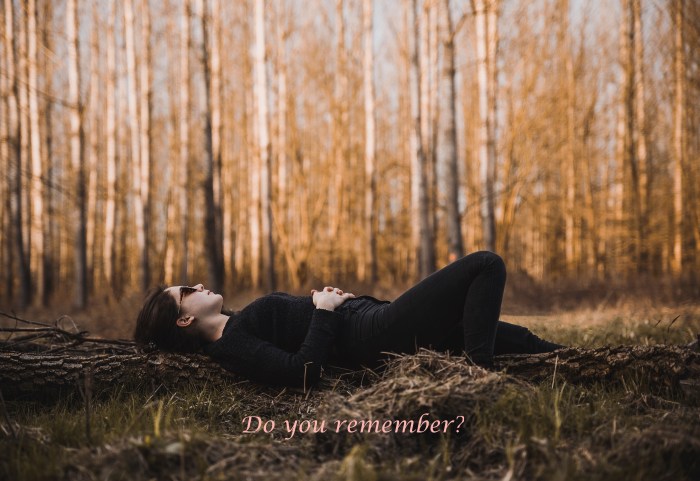
How do you remember who you are?

We are bombarded on every side with messages about who we are or are supposed to be. Messages come as ads from every source imaginable as well as news, talk shows, movies, music, and whatever peer groups we frequent. There are also the internal messages. Some of these are echoes from parents and childhood long ago.

It should not be surprising with all those loud messages out there that children and young adults are confused about who they are. But they are not the only ones. Adults of all ages are not immune from some of the messages.

blur-book-stack-books-590493

Those same messages create questions about who God is or at least blurs what we thought we knew or believed about Him. That can cause us to lose our mooring.

Little by little the study of history has been eclipsed by a metanarrative about social and cultural development. It takes only a reporter on the street asking a random person the most basic of questions to realize that few know the history of their country at even an elementary level. They don’t even know they don’t know and could seem to care less.

In 1905 philosopher George Santayana said:

“Those who cannot remember the past are condemned to repeat it.”

Then in 1948 in a speech to the House of Commons Winston Churchill slightly changed the quote of Santayana’s when we said:

“Those who fail to learn from history are condemned to repeat it.”

Though some may argue the relevance of studying history, there is a great deal of evidence to support the position noted in the two quotes.

anchor-beach-boat-1266847

God knew that very well. The Bible is not simply an historical book, but it contains history that anchors us to our place in creation and in our beliefs.

I think it is clear that God knew we needed reminders to remember who we are and who He is to us.

One example was the seven annual feasts that are laid out in Leviticus for the children of Israel after they were freed from slavery in Egypt. Each of them retold a different part of the story of who they were and who God was to them. The observance of these throughout the year was a reminder to them of how God had redeemed them and brought them to the Promised Land and provided for them.

This historical record and review was meant to solidify their identity for them as well as make clear who God was to them. These things also could remind them of what was good to remember as well as what was important not to repeat.

Reading what happened  serves as evidence they needed the reminder, but sometimes ignored it.

These feasts are not a part of the life of Christian believers today and in the midst of all that bombards us.

What is it that reminds me, reminds us of who we are and who God is to us?

IMG_0159

The Holy Spirit within us prompts us internally if we will pay attention. Time in the Word reminds us if we will cue ourselves and discipline ourselves to do it. Everything we see in nature can remind us as we take a breath, look up at the sky, feel the earth beneath our feet, hear the song of the bird overhead or the gurgling of a stream we walk by.

There are reminders all around us despite not having seven annual feasts. There are reminders beyond Christmas, Ash Wednesday, Good Friday, Easter, and Pentecost.

The course of our life will be strongly influenced by whether or not we tune in to all of these and others. Brothers and sisters along the way will also be able to remind us.

But we must not forget it is our response and responsibility to the grace and goodness of God to keep these things before us, to remember our history, our testimony with Him.

Other things, other people, and the enemy of our souls will seek to tell us who we are or should be. These are not the source of truth we need.

The Lord is the only One who can tell us and remind us of who we are with 100% accuracy, unending grace, and everlasting love. He never lies.

branches-cold-conifers-259620